Showing posts with label required reading. Show all posts

Wednesday, June 13, 2007

Required Reading #10 & #11: A Maile Meloy entry


Maile Meloy (yes, Colin Meloy's sister), has written two books (Liars and Saints and A Family Daughter) that were really clever in their ability to reinvent what an author can do with the tale of one family.

Liars and Saints

I devoured the first, Liars and Saints, during the last month of my pregnancy. At this time in my life (and now, really), my measure of a good book was how long I would be willing to stay awake to read it. (Or, similarly, how willing I would be to forgo a nap in order to read it.) For Liars and Saints, I was willing to do both.

It's not a remarkable story - a bit dramatic, a bit tragi-comic, and a bit romantic for my tastes - but it's really well told. It's about a family, and how that family evolves over two generations, and then loops back over on itself as a niece and her uncle fall in love, make love, and make a baby. Luckily, he's not really her uncle, but her cousin, which apparently makes it all that much better.

(For me, I'm not convinced that my personal sense of guilt and weirdness would be assuaged if I found out that I'd been procreating with my cousin and not my uncle, but when I posed the question to Kevin yesterday, he concurred with the characters - it's all that much better to get it on with your cousin rather than your uncle. As Kevin pointed out, "your uncle would be too much like your parents." And, really, it's far to generous to think that these novels have any Oedipal or Electra allusions.)

A Family Daughter

When I started this book a few days ago, I immediately was confused. Same character names, mostly same character characteristics, but some significant differences. For example, one character was tragically childless in Liars and Saints, and had two children in A Family Daughter. Question mark? Yes. I immediately suspected my 8-months-pregnant brain was responsible for my faulty memory of the the first book, even though I'd really just read it.

Then, I realized what was happening: Liars and Saints was a novel written by a character in A Family Daughter. Thus, creative differences between the two. The same insanity and drama
ensues, with some additional drama thrown in - let's hear it for Hungarian orphans purchased by Russians for prostitution who have affairs with French diplomats, who sell illegitimate offspring to wealthy Alzheimer-ailing French heiresses living in obscurity in Argentina, who is told the child is delivered to her via a European princess's interest in Romanian orphans. Whew, indeed. And that's only a small subplot!

It should be noted that in A Family Daughter, the niece and uncle who have an affair are really niece and uncle. Sorry, charlie - no hidden pregnancies which make them cousins in this tale! Luckily, no children either.

Unlike many other creative-types - Monet's million water lilies come to mind, or Pollack's splatter paintings - authors are limited in their ability to reinvent the same material. Without resorting to sequels, how can an author use a creative conceit to its fullest? I enjoyed these books because the offer one clever suggestion.

That, and they were easy to read.

Wednesday, May 30, 2007

Required Reading #9: Ice Haven

Let's hear it for the Mountain View Public Library, who are starting to carry a great array of graphic novels. I've avoided reading this one, mostly because I couldn't justify the price for the quantity of content, but I'm glad that I was able to get it for free - it's fantastic.

I'll be brief in description (since the book is brief in itself) and suggest that it's Daniel Clowes's homage to Sherwood Anderson's Winesburg, Ohio. That is: a portrait of a town, with all of its dysfunction, for us all to enjoy.

What's perhaps most remarkable about this novel is that each character believes himself to be at the pinnacle (or, I suppose, depth) of despair, only to learn that actually others are much more pathetic than himself. Indeed, the most pathetic character (Random Walker) is perhaps the only character who fails to view himself as such.

Did I like this book? Let's just say I dug out my I-make-you-go-blind tiny book lamp to read this last night, while baby Peter and Kevin softly snored next to me. (Of course, I compensated by taking a nap today. But. I gave up sleep to read this.)

Tuesday, May 29, 2007

reading list


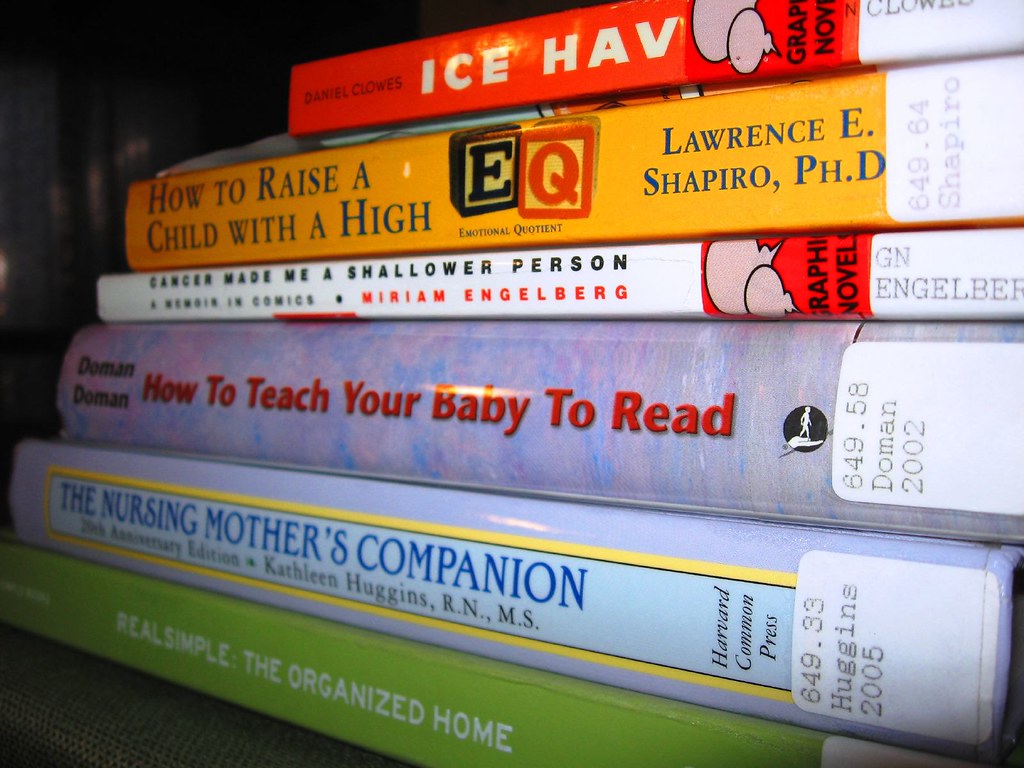
What's lamer? The fact that these are now the books I check out of the library, or the fact that I'll not even have the chance to read them.

Sunday, April 29, 2007

required reading?

Not really. Along with craft ADD, I've had reading ADD - I've not really been able to read anything longer than a magazine article for a while.

So, I thought I'd give myself a challenge with some chick-lit, and checked out The Jane Austen Book Club from the library.

It's pretty terrible, but I do enjoy this line:

"Now, often as not, when she thought of whist, sex came also to mind."

Hmm. I always thought the link was between a barouche and sex, since it always seemed that Austen's women went for ill-supervised carriage rides just before receiving a marriage proposal.

Tuesday, April 24, 2007

unfortunately...

Argh! A Series of Unfortunate Events is being released in paperback, but with extras, including an advice column titled "What shall I do, Lemony Snicket?" and something equally delicious sounding in the "Spoily Brats" comic.

Plus, check out the pulpish cover art!


My sense of frugality is battling my sense of Snicket-love, and I think I'm the only one who's losing.

Monday, February 12, 2007

Required Reading #8: the Yoshihiro Tatsumi collections


The first two releases:
The Push Man and Other Stories (1969) and Abandon the Old in Tokyo (1970)


Thank you, Drawn and Quarterly, for showing me exactly how I'll become bankrupt.

These comics are amazing, if depressing. (And mildly shocking: in the 1970 collection Abandon the Old in Tokyo, I wasn't really prepared for the man-on-dog action at all.) They're also ambiguous, open-ended, misanthropic, and surprisingly modern. A generic "everyman" highlights the often hidden side of the Japanese economic boom of the late 1960s - at times he is a sewerman, unclogging drains and avoiding eels and fetuses; other times, he endures in his marriage to a woman who alternately is having an affair or simply is a prostitute.

Remember, I said they were depressing.

Two in the collection have been released so far, with many others in the works. All I can say is that even at $20 each, they're worth it. The binding alone is worth it, really.

I'm trying to picture what the whole collecting would look like in my library, and finding myself turning into Homer Simpson: mmm...library.

Tuesday, January 16, 2007

Required Reading # 7: World War Z


Let's get this out of the way first: Yes, it's a book about zombies. So, technically, it's science fiction. (Pause to recompose. Continue.) But, it's really smart science fiction. And, David Sedaris told me to read it. So, there.

The world Max Brooks - the curious progeny of Mel Brooks and Ann Bancroft - has created is eerily plausible. Well...except for the zombie bits. I mean this with all seriousness, however: if you remove the zombie parts, it reads like the oral history of the avian flu, or the Spanish flu, or some heretofore undiscovered supervirus. There are no superpowers (unless you count China); there are no superweapons. It takes the U.S. Army a few years to realize that their fancy guns and body armor really aren't any match for something that can only be killed by a direct hit to the brain.

What I appreciated the most about the book, however, wasn't the military strategery, but rather the sensitivity to international relations. Brooks portrays a reasonable description of what the world would look like if in 10 or 15 years in the event of a catastrophic virus, like avian flu. Israel fares particularly well, due to what Brooks describes as a Jewish paranoia of mass extinction. Cuba also turns out well. Iceland? Not so well.

And who leads the U.S through all of this? No names are mentioned, but it's clear that Brooks has tapped Colin Powell and Howard Dean as Prez and Veep, respectively. Curious...

Friday, January 05, 2007

Required Reading #6: Water for Elephants


There was nothing about this book that I thought I'd like...an old man, remembering his circus days? Snooze-a-rama.

Plus, within the first 20 or so pages, I knew this would be the type of novel I dread: in which the major plot point is revealed at the start, and the rest of the novel just fills in details before and after.

I couldn't have been more wrong.

In a time in which I can barely keep my eyes open long enough to choke down a few pages of a graphic novel, I ripped through this book in just a few days. (I would have finished it more quickly, except for someone's insistence I go to sleep.)

In looking over the list of books I've read in the past year, I can easily say this is the best, by far. Perhaps in the past two years. Perhaps the best book I've read since The Plot Against America.

My only regret is that I'll have to return it to the library in a few days.

Thursday, November 30, 2006

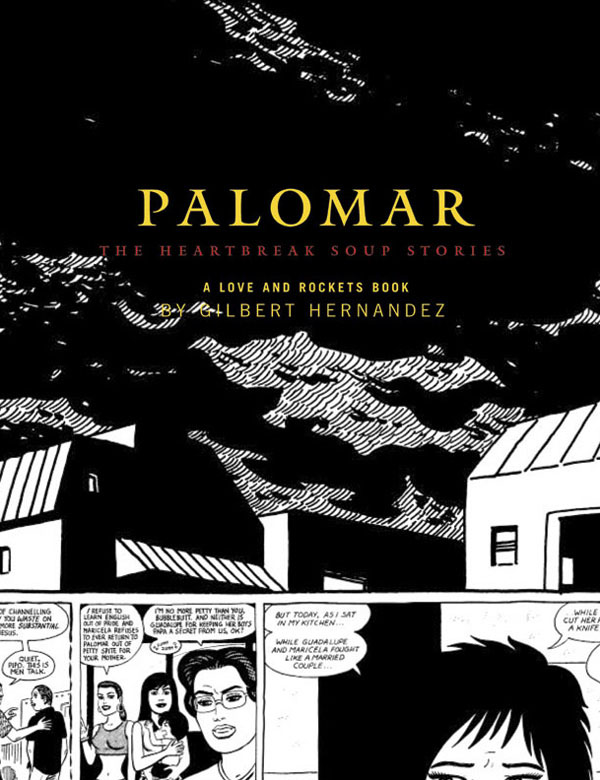
Recommended Reading #4 and #5: American Born Chinese and Palomar


The first graphic novel to be nominated for a National Book Award (albeit in the "Young People's Literature" category), Gene Yang's American Born Chinese is a tremendous book.

The stories (or, more properly, story) are clever and engaging, but that isn't why I appreciated the book so much. Mostly, I'm relieved to read a graphic novel that's not a retelling of some painful past experience. Maus and Co. aside, the graphic-novel-as-cathartic-release grows tedious when all you want is some lighthearted pre-bedtime distraction...


...which is why I was thrilled when I saw the Mountain View library had a copy of Gilbert Hernandez's "Palomar" comics from Love and Rockets. While it's not a proper graphic novel, it satisfies my need to consume more than a comic's standard 24 pages.

In a way, this book is terrible bedtime reading, as it's a 500 page oversized hardcover book. I really couldn't figure out how to hold the book while reading in bed. (An additional compaction was that I couldn't rest it on my stomach, as I would have otherwise.)

That said, it's not really good public reading either, as it is explicit in parts. I read it while in Indiana, and was afraid my grandmother would flip through it and find all of the steamy sex scenes. I can't even imagine her incomprehension.

Seriously, though, Palomar is great. The town that Gilbert Hernandez has created is a curious mix of pure feminism (women seem to be the only competent people in town; the sheriff and the mayor are both incredibly strong females) and pure sexism (apparently, all women must wear skirts - the only woman who does not wear a skirt is the steroid-popping bodybuilder). While the end is weak - and drifts too far into magic realism for my tastes - the other 450 pages more than make up for it.

Saturday, October 14, 2006

Required Reading #3: The End

"In my experience, well-read people are less likely to be evil."
Quigley Quagmire,
The Slippery Slope


Oh. My. Word.

It's almost perfect!

Be well-read and read it, pronto.

Sunday, October 01, 2006

Required Reading #2; Additional Literary Notes

Required Reading #2
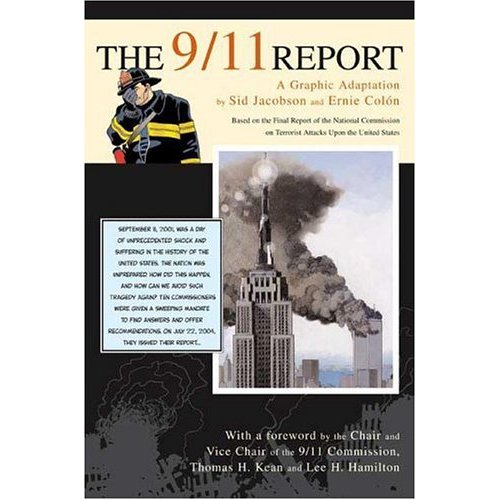
Despite the (modest) criticism it's received, I'm going on a limb and making Sid Jacobson and Ernie Colon's 9/11 Report: A Graphic Adaptation Required Reading #2, for two key reasons:

First, this book is a faithful adaptation of the 9/11 Commission's report. You know, that book that nearly every American purchased but never really read past the "We Have Some Planes" section? Clearly, it's an abridgment, but with the imprimatur of Tom Keane and Lee Hamilton themselves, it's a well-conceived abridgment.

Second, it's really well done. It's sentimental and journalistic, logical and emotional. The graphic novel is a literary form that may be singularly adept at relating human tragedy in a humane manner - see Joe Sacco, for example.

Additional Literary Notes
(1) In preparation for the release of Book the Thirteenth: The End, I'm going to re-read the first 12 Lemony Snicket books, one per day. Wish me luck.

(2) Speaking of Lemony Snicket, I've just finished Daniel Handler's new book (Adverbs) and am delighted to report that he did not steal my idea for the as-yet-unfinished novel I am "working" on.

(3) I kind of secretly like Chuck Klosterman, mostly because does stuff like call Steve Nash a communist. But, really, don't hold it against me.

Thursday, August 31, 2006

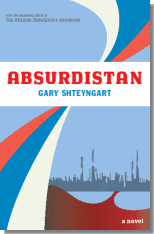
Required Reading #1: Absurdistan

There are all of these terrible people in the world who will insist that you ought to read John Kennedy Toole's A Confederacy of Dunces. To get you to take the bait, they'll use all of the right words - "cult favorite," "biting social commentary," and "wickedly hilarious." And, if you're particularly weak, or if the pusher is particularly malevolent, you find yourself knee-deep in the midst of this vile, vile tome.

I propose that Gary Shteyngart's Absurdistan is exactly what those Confederacy of Dunces admirers hoped their book would be. A few examples:

- it features a hygenically-challenged and obese protagonist in Misha "Snack Daddy" Vainberg;
- it critiques modern intelligentsia by exposing the role of Accidental College and its Multicultural Affairs major and its motto "Do you think one person can save the world? So do we!"
- and, most damningly, it combines the role of the media, petroleum, war, and the American firm "Golly Burton."

But mostly, it's just really hilarious. How can you lose with lines like "Along the way, we took turns hitting the driver with birch twigs, ostensibly to improve his circulation, but in reality because it is impossible to end an evening in Russia without assaulting someone" (Shteyngart 2006 : 76)?

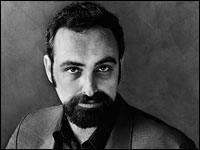
Also, and not to be petty about it, but doesn't the author kind of look exactly how a brooding Russian author ought?